02 / EMIT electric road wheelsIn development
Electric wheels.
Electric traction at the road wheels, developed as part of the coordinated JRIVE package.
Design studies and 3D assemblies available

For the car you want to keep
A smart steering wheel. EMIT electric road wheels. E-CRATE energy. Three connected products, built around the car you want to keep.
In development. Planned to launch together as a coordinated package, with vehicle-specific engineering and validation.
Three products
One planned launch
A shared core
A connection for your car
CONCEPT RENDERING · IN DEVELOPMENT
What JRIVE is / In development
A proposed computing and control hub, with a connection kit for your car.
01 / The wheel you use
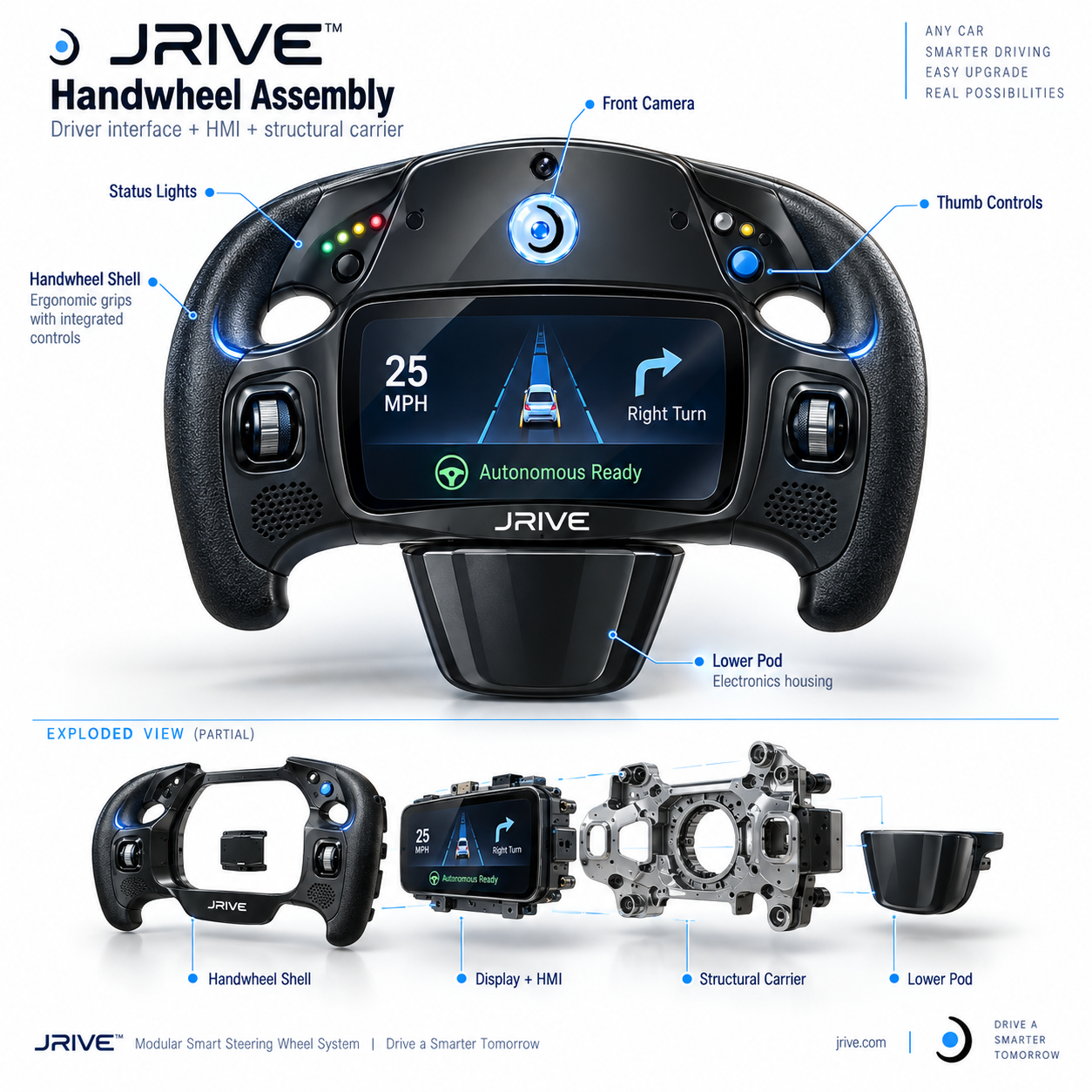
The screen, buttons and grips sit on a shared inner frame, connected to the steering parts behind the wheel.
The parts, simply explained
See what each module is, how its parts come together and what it is there to do. Open a study for its original annotated design and deeper detail.
Illustrated concept construction. Production materials, manufacturing and specifications remain in development.
Vehicle showcase / Three generations
The 1969 Beetle, 2003 Civic and 2015 Tacoma are familiar vehicles from different generations. These proposed studies show how the same core could connect to each car—and what a fuller future upgrade could involve.
Prototype vehicle studies, not confirmed installations. Each car needs its own measurements, secure mounting and complete system checks.
Why upgrade? / Modeled possibilities
Pricing is in development. Customer cost scenarios are being prepared for this preview; engineering calculations remain in the technical companion.
05 / Connected by design
The smart steering wheel, EMIT electric road wheels and E-CRATE — Electronic Crate Battery (ECB) — are planned to launch together. One coordinated package, in development around the vehicle you want to keep.
Electric traction at the road wheels, developed as part of the coordinated JRIVE package.
E-CRATE — Electronic Crate Battery (ECB) — supplies body-side energy and supporting power services for the planned coordinated system.
The installation network / Future vision
JRIVE Stations are a proposed way to modernize vehicles locally: transform existing automotive repair shops across the country into high-tech product showrooms and installation centers.
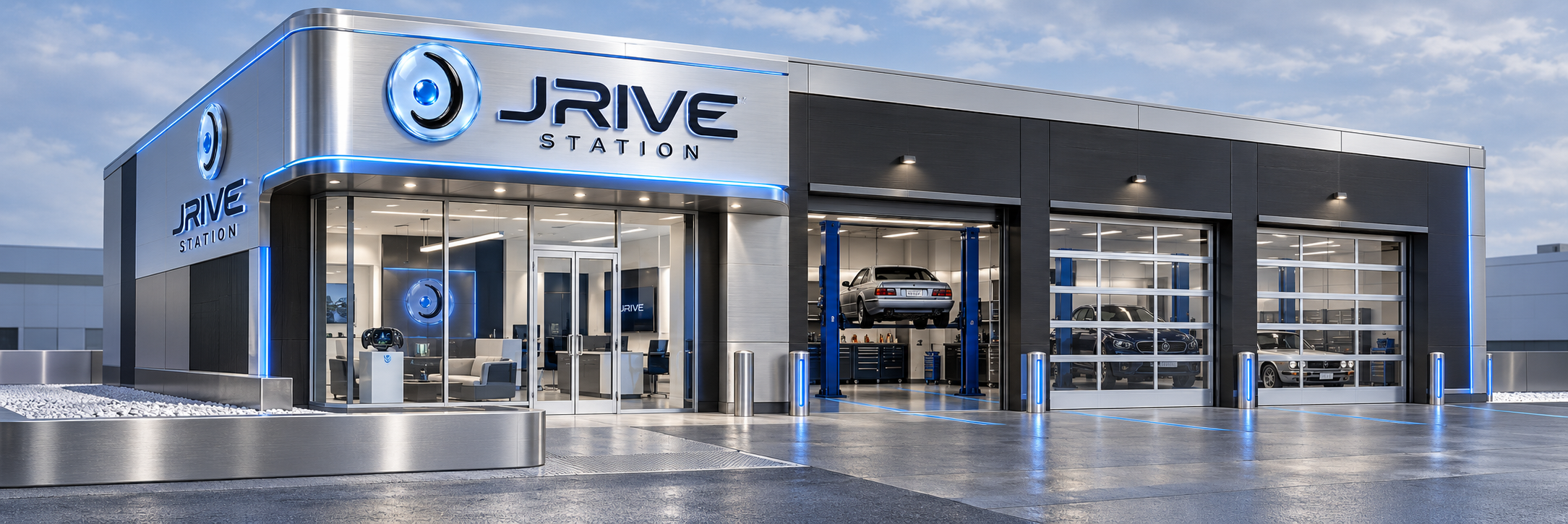
A future Station concept for professionally assessed upgrades. The steering wheel, EMIT and E-CRATE are planned as one coordinated product launch.

JRIVE / DRIVE FORWARD
06 / Connect with JRIVE
JRIVE is developing a coordinated package for existing vehicles: a smart steering wheel with a screen and computing hub, EMIT electric road wheels and E-CRATE energy storage. All three are planned to launch together.
Vehicle owners, installers and shops can explore the vision alongside investors and engineering collaborators. Prepare a short introduction to share with your JRIVE contact.
Download the concept briefA few practical questions
The three-product story is now available to explore: turn the steering wheel, open the EMIT motor assembly and look inside E-CRATE. Each has a detailed 3D presentation, selectable parts and engineering references.
The next work is physical: build and measure hardware, establish vehicle fit, develop the controls and test the complete system. The models make the plan visible; they do not establish a manufactured or road-ready product.
JRIVE is in development. The smart steering wheel, EMIT electric road wheels and E-CRATE — Electronic Crate Battery (ECB) — are planned to launch together as a coordinated package for compatible existing vehicles. There is no announced retail price, release date or production availability.
You can now explore all three products in the interactive product studio, turn the assemblies through different angles, open their parts and inspect the supporting references. That presentation work is complete enough to review. Building working hardware, confirming suppliers, validating installation and establishing a supported production package remain development work.
Vehicle owners, workshops, investors and engineering collaborators can use Connect to start a conversation about their interest. Pricing and an installation plan would follow an assessment of the vehicle and the intended package.
The proposed journey begins with a survey of the actual vehicle: condition, structure, steering column, wheel mounts, brakes, suspension travel, electrical services and space for the battery. That survey would establish which original features can stay and which connections need to change. The aim is to keep the body, cabin and character you know while replacing or adding the technology the chosen upgrade requires.
The steering wheel provides the driver interface and a vehicle-specific steering connection. EMIT puts electric traction at the road wheels. E-CRATE supplies stored energy and protected power services. A full-electric installation also needs charging, cooling, friction braking, secure mounts and verified vehicle controls. Sensors and independent vehicle supervision would be added for any proposed automated functions.
A professional installation would finish with mechanical, electrical and control checks appropriate to that particular vehicle. The five-step car scenes and station visit show the intended experience; they are not a released workshop procedure or a promise of a fixed installation time.
The goal is a shared modular product family with connections designed for each vehicle. The steering assembly needs a compatible column connection, secure support and the correct control interfaces. An EMIT road wheel needs a suitable hub pattern, offset, rim and tire envelope, load capacity, brake arrangement and clearance through the suspension's full travel and steering range.
The three EMIT tire styles in the studio show a road tire for the Civic, a taller classic profile for the Beetle and a heavier all-terrain profile for the Tacoma around the same displayed motor core. These are appearance comparisons. They do not establish that one physical motor, bearing or brake specification meets the loads of all three vehicles.
The Beetle, Civic and Tacoma are development studies, rather than an approved fitment list. Donor measurements, load cases and testing must establish a usable configuration for each car. The EMIT engineering notes describe the current source geometry, reference parts and remaining work.
No. The 3D studio now shows three complete visual assemblies with opening parts, selectable explanations and CAD references. The steering wheel and EMIT include supplied engineering geometry beneath their finished appearance studies. E-CRATE uses newly authored reference geometry developed from the R1 documents. Materials, tread, fasteners and other presentation details help explain the proposed products; their appearance is not evidence of a manufactured component.
The editable CAD and document tree support design review. They do not prove motor output, battery capacity, brake performance, crash protection, electromagnetic compatibility or durability. Those results require physical components, instrumented tests and a properly integrated vehicle. The finished display and its engineering sources remain distinct throughout the technical pages.
Automated driving would also require calibrated sensors, perception software, independent vehicle supervision, qualified steering and friction braking, and validation within defined operating conditions. The steering-wheel screen displays information and permits requests. Proposed AVC supervision is separate from that interface, and essential local operation is designed to remain independent of a phone or cloud connection. No JRIVE autonomous-driving performance or road approval is established by this preview.
Use Connect to prepare an inquiry for Morgan at morgan@mycosoft.org. Choose vehicle owner, installer or shop, investor, or engineering collaborator, then describe the conversation you would like to have. The inquiry includes a PDF of your details for JRIVE to review. Sending opens FormSubmit to complete its verification and confirmation, then brings you back to JRIVE.
For a vehicle inquiry, include the year, make, model, location, current condition and what you want to retain or change. Shops can describe their facilities and installation capabilities. Engineering collaborators can identify the component or system they want to work on, and investors can ask for a discussion of the program and its current stage.
No price, installation slot or delivery date has been established through the website. We would first clarify your requirements, then discuss the appropriate next step.
EMIT means Electronic Motor in Tire. The traction motor sits inside the road-wheel assembly, within the rim, and turns the road wheel directly. It is not a motor built into the rubber. The concept combines a rotating outer motor assembly with a fixed electromagnetic core, bearings, braking and wheel-side control. Opening the EMIT 3D model shows those roles separately.
E-CRATE is the Electronic Crate Battery (ECB). It stays with the vehicle body and supplies energy through protected power services. Its proposed battery banks, battery management, charging, cooling and low-voltage reserve support the drive system and retained vehicle services. The traction motors are in EMIT; the primary E-CRATE architecture does not add a central traction motor.
The smart steering wheel is the driver's screen, physical controls and computing interface. Proposed AVC vehicle supervision handles requests independently, with perception in its own domain. A wired JRIVE Link is the candidate connection across verified modern or older vehicle interfaces; optional wireless observations and permitted requests do not replace the local motion-control path. All three products are planned together, with vehicle-specific integration.
E-CRATE is organized around battery modules grouped into serviceable banks and an attached power-service assembly. Battery management would monitor cells, temperatures and currents and publish operating limits. Protected distribution, switching and precharge would connect the banks to EMIT and selected vehicle services. Charging equipment, thermal management and a reserve for critical low-voltage loads are separate parts of that plan.
The number and position of banks depend on available space, desired driving use, mass, axle loads, payload, cooling and service access. More capacity adds weight and volume. The R1 document's example families are engineering assumptions to evaluate, rather than selected customer battery capacities or verified range. A complete installation may need several protected locations, even when the illustrations show one crate in a former engine area.
Cell selection, usable capacity, charging connectors, charging rate and battery life remain to be established and tested. No range or charge-time promise is available. Explore the E-CRATE model and component tree or the R1 engineering notes to see what is defined and what remains open.
The studies use a 1969 Volkswagen Beetle, 2003 Honda Civic and 2015 Toyota Tacoma. They illustrate a classic rear-engine car, an everyday older front-engine car and a more recent truck. Their sequences keep the original road wheels through the steering-wheel and sensor stages; the electric-wheel stage introduces EMIT, followed by the proposed complete package.
The Beetle concept puts E-CRATE in the former rear engine area, close to two rear EMIT drive wheels, leaving the front luggage area distinct. That makes the proposed short rear power connections easy to explain. The Civic and Tacoma concepts use their former front engine areas. The Civic studies consider front-drive and four-wheel arrangements; the Tacoma direction calls for truck-class drive wheels and a vehicle-specific load review.
These are placement studies, not confirmed kits or measured battery fits. The finished bank arrangement, mounts, restraints, cooling, wiring, braking, axle weights and access must be assessed on the actual vehicle. The plan for the Beetle's rear-wheel connections and steering interface is an architecture to develop and test; it does not establish a released single-wire or wireless installation. The objective remains the same for all three: keep the familiar vehicle while engineering a complete, supported upgrade.